



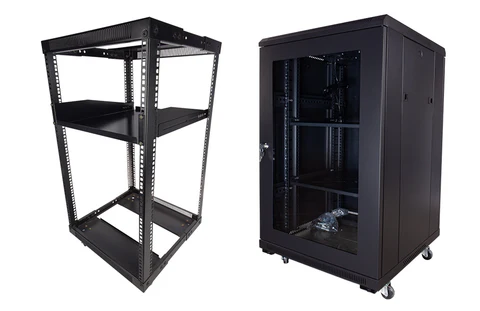
When planning the placement of servers and networking hardware, choosing between an open frame rack and a closed cabinet is one of the first major tasks. This decision affects more than just the appearance of the server room; it impacts how the equipment is cooled, how easily it can be serviced, and whether it is protected from unauthorized access. In the debate of open rack vs closed rack, there is no single right answer – it all depends on your budget, the type of room, and your specific technical requirements.
Open Frame Racks: Simplicity and Accessibility
An open frame rack is a durable steel framework without side panels or doors. It is well-suited for operation in specially prepared rooms that already feature centralized climate control and where the risk of outside interference is eliminated at the entrance to the server room itself.
For serious tasks in this category, the most reliable choice is the 4 post equipment rack. Unlike lightweight 2-post designs, this model secures equipment at four points (front and rear profiles). This allows for the safe installation of heavy hardware: servers with depths up to 1000 mm, massive uninterruptible power supplies (UPS), and storage arrays, without the fear of the frame warping or expensive components falling under their own weight.
Pros of the Open Type:
- Maximum Natural Cooling. Air circulates freely around the equipment. There are no barriers to stop hot exhaust from moving toward the room’s return vents, minimizing the risk of overheating within a specific server.
- Instant Access. Technicians don’t need to waste time with keys or removing heavy side panels. All ports, cables, and indicators are in direct line of sight, which is convenient for routine maintenance or frequent re-cabling.
- Cost Savings. These structures use less metal and lack expensive tempered glass or locking systems. This significantly reduces the cost of setting up an IT node, allowing resources to be redirected toward purchasing more powerful servers.
- Flexible Cable Management. The absence of physical boundaries allows cable runs to be routed in any direction. This simplifies network scaling, adding new patch cords, and installing additional horizontal or vertical organizers.
Closed Server Cabinets: Protection and Control
A closed rack is a full protective enclosure for servers, equipped with side panels and doors. This solution is chosen when it is necessary to create an isolated and secure environment for important systems, especially if unauthorized access is possible within the facility.
Pros of the Closed Type:
- Security and Access Control. All doors and panels are equipped with locks. This is the primary argument if the rack is placed in a location where it is necessary to exclude any interference from unauthorized persons or accidental damage to the hardware.
- Acoustic Comfort. Server equipment generates a significant amount of noise. The solid steel walls of a cabinet act as a sound barrier, which is important if the IT equipment is located in the same space as employee workstations.
- Protection from the External Environment. The cabinet protects electronics from dust and moisture. It is much easier to maintain cleanliness inside a closed structure, which directly impacts the stable operation of fans, power supplies, and motherboards.
- Airflow Management. A closed design allows for organized forced ventilation. By using fan kits and blanking panels for empty units, you can create a directed airflow that passes strictly through the server intakes, increasing the overall efficiency of the cooling system.
Direct Comparison: What to Consider?
In the open rack vs closed rack discussion, it is worth considering not only current needs but also future network expansion. For example, an open rack is much easier to adapt for non-standard devices that might protrude slightly beyond the typical depth of the frame. A closed cabinet, however, strictly limits you with its internal dimensions.
A closed cabinet also helps maintain visual order in the workspace. If servers are in plain view of employees, the cabinet hides the chaos of wires and blinking lights, turning the technical area into a tidy element of the office. Additionally, many cabinets are supplied on heavy-duty casters, allowing a heavy structure to be moved with all its contents without complete disassembly.
Dimensions and Load Capacity
Open racks are generally lighter and easier to assemble, disassemble, and move. Closed cabinets require more careful planning during delivery (they may not fit through narrow doorways in an assembled state) and place a greater load on the floor due to the weight of the steel panels, heavy doors, and hardware.
Summary: Which Option is Best for You?
Choose an open frame rack if:
- You have a dedicated, secure server room with professional climate control.
- You need to minimize the cost of server furniture.
- You require constant and unobstructed access to the rear panels of equipment for frequent testing.
- You are certain that the risk of outside interference is eliminated at the room-access level.
Choose a closed cabinet if:
- Servers are located in common areas or offices where people work.
- Compliance with corporate security standards is required.
- You need to reduce noise in the room and protect equipment from dust accumulation.
- You need to hide a mass of cables so the equipment area looks professional and neat.
The right choice between a rack and a cabinet is the foundation of a stable digital infrastructure. Evaluate your cooling capabilities, the real threat of unauthorized access, and your budget – and you will understand which option is the optimal home for your hardware.


