



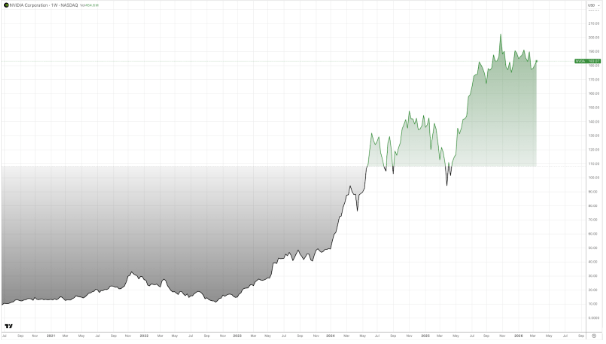
The surge in interest in AI infrastructure continues to reshape the technology sector. Beyond computing needs, companies are increasingly challenged by supply chain constraints. Nvidia remains a key beneficiary of this trend, as reflected in the Nvidia stock performance, but faces the need to balance regulatory risks, intensifying competition, and rising costs.
One of the most notable signals was the resumption of H200 accelerator production for the Chinese market. After a prolonged pause, the company obtained U.S. export licenses and aligned them with the import approvals from the Chinese authorities, which allowed the supply chain to recover. China remains a key growth destination, and the return of H200 shipments indicates a partial normalization of trade flows in the AI accelerator segment, despite ongoing regulatory pressure.
At the same time, Nvidia is actively diversifying its product strategy to maintain its position amid the intensifying rivalry from local competitors. We are talking not only about traditional GPUs, but also about specialized inference solutions, particularly chips based on Groq’s developments. The company is preparing tailored versions of these products for the Chinese market, adapting to export restrictions while preserving performance. This approach demonstrates the transition to a more flexible model with focus on compatibility and integration optimization rather than limiting functionality.
Simultaneously, Nvidia is accelerating its transformation into a full-fledged platform company. The Agent Toolkit and NemoClaw tools — presented at GTC — lay the foundation for large-scale delpoyment of AI agents in enterprise environments. By integrating them into the company’s existing solutions and securing partnerships with companies like Adobe, SAP, and Salesforce, the stock screener leader enhances the ecosystem dependency effect. This approach not only stimulates the demand for its own hardware, but also establishes it as a standard for building an AI infrastructure.
However, despite revenue growth and product line expansion, pressure from commodity markets is increasing. One of the most notable examples is the cobalt market: prices have surged by more than 160% amid export restrictions from the Democratic Republic of the Congo, which accounts for over 70% of global production. The emerging shortage — potentially persisting until the end of the decade — is already leading to an increase in costs in related industries, from batteries to electronic equipment. This adds inflationary pressures across the high-tech products supply chain.
The reduction in refined cobalt production and the structural depletion of reserves further aggravate the situation. Although some of the shortfall is offset by alternative supplies, such as from Indonesia, the sustainability of these sources raises questions due to logistical, environmental, and resource constraints. As a result, companies are increasingly investing in supply diversification and substitute materials, which in the long term may change the demand structure.
Taken together, these factors point to a more complex investment landscape. On the one hand, Nvidia remains a key driver of the AI sector’s growth by scaling the infrastructure and expanding the ecosystem. On the other hand, the risks associated with geopolitics, dependence on individual markets, and rising costs are creating pressure. For investors, this means moving from a high-growth phase to a more balanced assessment, where, along with potential, supply chain constraints and cyclical demand for AI infrastructure are taken into account.


