



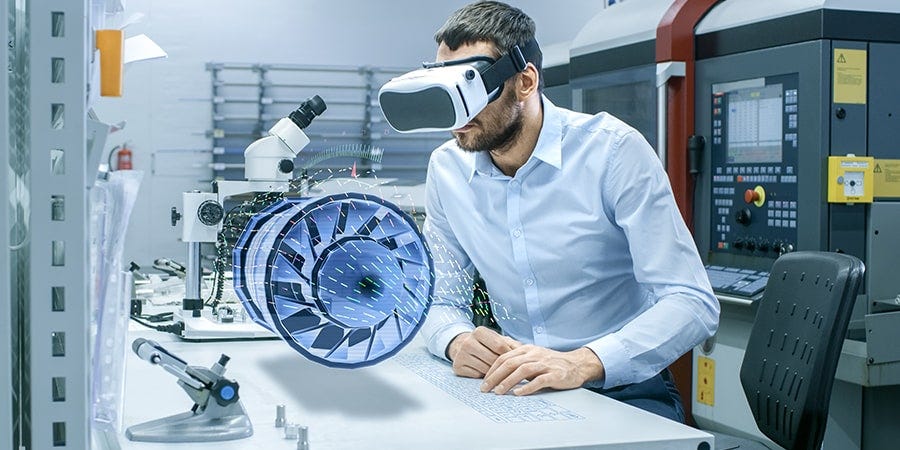
In the crucible of innovation, where molten ideas are forged into real-world solutions, the realm of manufacturing has always been at the forefront. The arc of this industry’s transformation takes a decisive leap into the future with the advent of Industrial Augmented Reality (AR). This article is not a mere assembly line of information but is designed to custom fit the needs of modern manufacturing professionals who are keen on seizing the power of AR to catalyze operational efficiency and outpace the competition. We’re peeling back the steel curtain on this mind-bending technology that is quickly becoming not just a nice-to-have, but a must-have in the industrial sector.
AR at the Helm of Modern Manufacturing
The Rise of the AR Revolution
Industrial AR is like a magical pair of x-ray goggles for the production floor, allowing workers to see everything from hidden machinery parts to complex engineering schematics — laid bare before their eyes in the form of holographic overlays on the real-world environment. The implications for training, maintenance, and even complex production tasks are nothing short of revolutionary. Industrial AR solutions are being adopted by major players such as GE, Boeing, and BMW who have all reported significant improvements in efficiency and productivity since implementing AR technology.
Leading the Efficiency Charge
Imagine a scenario where a seasoned technician faces a complex repair task — arduous manuals and blueprints spread across workbenches, each one an obstacle between the technician and a swift resolution. AR sweeps these hurdles aside. It not only guides workers step by step through interactive visual cues but also draws from institutional knowledge in real-time, heralding a new era of efficiency and precision that borders on the virtuosic.
Bridging the Training Gap
The manufacturing sector worships at the altar of knowledge transfer where experience is gold. With an aging workforce nearing retirement, AR presents an elegant solution. It’s a medium through which veterans can deposit their expertise into a digital repository, one that new recruits can tap into, with nary a word being spoken. This bridge between generations ensures that the mystical trade secrets of old are not lost, but merely augmented.
Crafting a Digital Drama for Machinery
Simplifying Complex Operations
Industrial AR is not just about fusing reality with digital elements; it’s about creating a narrative for machinery and processes that anyone can comprehend. Take, for example, the intricate choreography of a CNC machine. AR can simplify this dance into a digestible storyline that operators can follow, anticipate, and maintain without missing a beat.
The Human-Tech Tango
The beauty of AR in manufacturing is its facilitation of a seamless human-technology partnership, where both work synergistically, each enhancing the capabilities of the other. Complex machines become instruments of an effortless symphony, directed by the conductor’s wand of AR — or in modern parlance, a handheld device or smart glasses.
The Maintenance Mindset
The saying goes, “An ounce of prevention is worth a pound of cure.” In manufacturing, no truer words have been spoken, and AR takes this axiom to heart. By instituting predictive maintenance protocols powered by AR, manufacturers can replace reactive scrambles with proactive measures. Parks full of idle machines awaiting service are eclipsed by a predictive AR that schedules maintenance only when needed — a digital butler that serves you tools when you didn’t even know you needed them.
The Nuts and Bolts of AR Integration
Overcoming Resistance
Any monumental shift in an industry is met with resistance — and AR is no exception. The challenge lies in demonstrating ROI, cultural alignment, and the allaying of fears that it could remove the human element from a predominantly hands-on industry. The trick is to not just integrate AR into manufacturing operations but to weave it into the very fabric.
Making AR More Than a Gimmick
To those who view AR as nothing more than a novelty, they have yet to see its application in the real world of manufacturing. It is crucial to portray AR as a critical tool in the arsenal of modern manufacturing — not just a showpiece.
Setting a Vision for Implementation
The best outcomes from AR adoption come not from blindly digitizing a process but from reimagining the process entirely. It’s about setting a clear vision for how AR can enhance manufacturing, aligning it with business objectives, and executing a roadmap that delivers real, tangible benefits.
AR Adoption: A Case for Flexibility
Scaling Across the Value Chain
Adoption of AR in modern manufacturing is not a one-size-fits-all endeavor. Considering the diversity present across the manufacturing spectrum — from automotive to aerospace to consumer goods — the applications must be tailored to the specific vertical, taking into account unique workflows, challenges, and opportunities.
Regulatory Hurdles and Safety Nets
Another important facet of AR in a manufacturing setting is to ensure conformity with existing regulations. Safety guidelines, quality control measures, and industry standards are the safety nets that dictate the extent and manner of AR integration. The onus is on manufacturers to pilot programs that demonstrate not just the effectiveness but the compliance of AR.
Reshaping the Narrative of Labor
With AR taking on the more complex and repetitive tasks, the narrative of labor in manufacturing is rewritten. It’s not about job displacement but rather job evolution — where humans’ roles become more strategic, creative, and qualitative, while monotonous tasks are delegated to AR-enhanced workflows.
Future-Proofing with AR
A Glimpse into Tomorrow’s Factory Floor
The convergence of AR with other emerging technologies like IoT, AI, and robotics is akin to the formation of a technological Voltron. This unified front promises a manufacturing future that is not just efficient but anticipatory. The modern factory will be a living organism, its parts not just working in tandem but in harmony — a cyber-physical ballet of unprecedented sophistication.
The March Towards Universal AR
We are on the cusp of an era where AR becomes as ubiquitous on the factory floor as cranes and conveyor belts. The vision to make every substantial object a “smart object” — one that can communicate, educate, and operate with the aid of AR — is not just a pipe dream. It is fast becoming a reality that manufacturers need to prepare for.
Summoning the AR Revolution
Preparing for the Future Today
The adoption of AR in modern manufacturing is not a question of if, but when. The competitive advantage it brings in terms of quality, cost, and innovation is too compelling to ignore. The time has come for manufacturing professionals to take the leap into this holographic realm, and to do so with gusto, is to secure a pivotal position in the production story of the 21st century.
In conclusion, AR in the manufacturing sector is not just a tool to see the future, but a means to shape it. It is a tangible lens through which the inefficiencies and obsoletion of traditional methods become glaringly apparent. By investing in AR, manufacturers invest in their ability to not just keep up with the pack, but to accelerate ahead, flag in hand. The future of manufacturing is here, and it’s got holograms.


