



That low-battery warning isn’t just annoying — it can disrupt our day in meaningful ways. When your phone dies, you might miss an important call, lose touch with friends, or be unable to access something you need on the go. These small moments add up, affecting how we connect and communicate.
For students and professionals, running out of power during work or study can stop productivity cold. And in unfamiliar places, a dead phone can even mean losing access to maps or digital payments. In today’s connected world, staying charged isn’t just convenient — it’s part of feeling prepared and secure.
Why Your Old Power Bank Isn’t Enough Anymore
If you have a power bank from a few years ago, you probably think of it as a “last resort” device. It was likely a small 5,000mAh unit that charged your phone slowly, maybe giving it one full charge if you were lucky. It was helpful, but not life-changing.
Welcome to the new era. Today’s power banks are a quantum leap forward, defined by two key metrics: high capacity and high power.
High Capacity (More Juice): Measured in milliamp-hours (mAh), capacity is your fuel tank. While 5,000mAh was once standard, 20,000mAh is the new sweet spot. This isn’t just an incremental upgrade; it means you can charge a flagship smartphone 4-5 times, or fully charge your phone, your headphones, and your smartwatch, with power to spare.
High Power (More Speed & Versatility): Measured in watts (W), power is how fast that fuel is delivered. Older power banks trickled out power at 5W or 10W. A modern fast charging power bank equipped with protocols like USB-C Power Delivery (PD) can output 30W, 65W, or even more. This means charging your iPhone from 0 to 50% in about 30 minutes. More importantly, this high wattage is what finally makes charging larger devices a reality.
Unlocking True Mobility with a High-Capacity, High-Power Power Bank
This combination of high capacity and high power isn’t just better—it’s transformative. It unlocks new ways to work, travel, and live without ever thinking about an outlet.
For the Digital Nomad & Remote Worker: Your Office is Anywhere
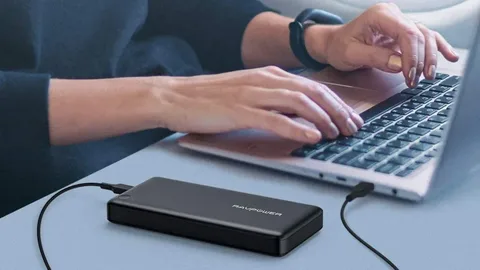
Imagine this: you’re finishing a presentation for a deadline. Not in a stuffy office, but on a park bench with a nice breeze. Your laptop’s battery icon is a happy, full green. This isn’t a fantasy. With the right portable charger, you can charge laptop with portable charger just as you would from a wall. A powerful laptop portable power bank, especially a 100w power bank, can keep a MacBook Pro or a Dell XPS running for hours, giving you the ultimate freedom to work wherever you feel most inspired.
For the Avid Traveler: Conquer Long-Hauls and Layovers
Airports are notorious for their lack of accessible outlets. Instead of huddling on the floor next to the only available plug, you can relax at your gate, knowing you have all the power you need. A single high-capacity usb c power bank can power your phone through the entire flight, keep your noise-canceling headphones alive for that in-flight movie, and still have enough juice to top off your tablet upon landing. It’s the ultimate travel peace of mind.
For the Content Creator & Gamer: Uninterrupted Passion
Mobile gaming and video recording are two of the most battery-intensive tasks you can perform. For gamers, a powerful fast charging power bank means you can play demanding titles without the battery percentage dropping faster than your in-game health bar. For vloggers and content creators, it means you can film for hours outdoors without worrying that your phone will die right as you capture the perfect shot.
How to Choose the Right Power Bank for YOU: A Step-by-Step Guide
Convinced? Great. Now let’s find the perfect one for you. Don’t just grab the first one you see. Choosing the right power bank is about matching it to your specific needs.
Step 1: Assess Your Daily Arsenal – What Devices Do You Carry?
The Minimalist (Phone Only): If you just need to keep your smartphone alive, a slim 10,000mAh power bank is a great choice. It’s often the smallest power bank you can find that still offers fast charging, and it will give you 2-3 full phone charges.
The Everyday Power User (Phone, Headphones, Tablet): This is where 20,000mAh becomes the gold standard. It has the capacity to handle all your daily devices and usually comes with multiple ports so you can charge them at the same time.
The Mobile Professional (Laptop User): If your goal is to charge laptop with portable charger, this is non-negotiable. You need a dedicated laptop portable power bank. Look for a capacity of at least 20,000mAh and, crucially, a power output of at least 65W. For more powerful machines like a 16-inch MacBook Pro, a 100w power bank is the ideal choice to ensure you can charge at full speed.
Step 2: Decode the Specs Like a Pro
Capacity (mAh): A simple rule of thumb: divide the power bank’s mAh by your phone’s battery mAh and multiply by about 0.8 (to account for energy loss). A 20,000mAh power bank will charge a ~4,500mAh phone about 3.5 times.
Power Output (Watts & Protocols): Check that the power bank supports the fast-charging protocol your device uses (e.g., Power Delivery for iPhones and most modern Androids/laptops). The Wattage (W) on the power bank’s port should be equal to or greater than what your device can handle for the fastest speeds.
Ports (Input & Output): A modern usb c power bank with a bi-directional USB-C port is a must. This means you can use that same port to fast-charge your devices and to rapidly recharge the power bank itself.
Safety & Airline Regulations: Reputable brands include protection against overcharging, short-circuiting, and overheating. For air travel, the FAA limit is 100 watt-hours (Wh).
Step 3: Balance Power with Portability
There’s a direct trade-off: more power means more weight and size. A massive 25,000mAh, 140w power bank is a lifesaver for a remote worker but overkill for a night out. Be realistic about what you’re willing to carry every day and find the balance that’s right for you.
A Standout Example: The INIU 100W Laptop Power Bank
If you’re looking for a perfect example of a power bank that masterfully balances these features, a standout choice is the INIU 100W 25000mAh Laptop Power Bank (model P63-E1). It hits the sweet spot for a huge range of users. Its 100W USB-C Power Delivery output is powerful enough to fast-charge not just your phone and tablet, but also a MacBook Air, Dell XPS, or other compatible ultrabooks at impressive speeds. Combined with its substantial 25,000mAh capacity, it has enough juice to keep you going for days.
But what truly sets it apart is its incredible design. For its immense power and capacity, it’s remarkably compact and portable. It is one of the smallest power bank in its class (100W, 25,000mAh) on the market. With three ports to charge multiple devices at once and a clear digital display, it’s a prime example of a device that doesn’t force you to compromise between power and portability, making it an ideal choice for everyone from the daily commuter to the digital nomad.
Conclusion
Low battery anxiety doesn’t have to be a part of your daily life. By understanding your needs and choosing the right tool for the job, you can break free from the constant search for a wall outlet. A modern, high-capacity, high-power power bank is more than just an accessory; it’s a declaration of independence. It’s the key that unlocks the freedom to focus on your work, your travels, your passions, and your connections—not on a declining percentage.
Stop letting your battery dictate your day. Invest in a power bank that fits your life, and reclaim your mobile freedom today.


