



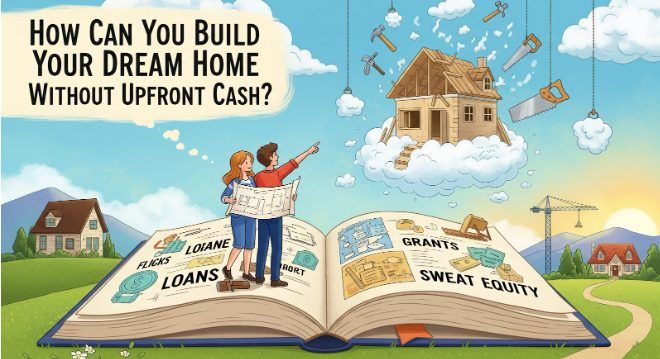
Is it possible to construct your dream house without a mountain of cash in the bank?
The answer is yes. It is not magic and it is not free money. It is all about being clever with what you possess and understanding that banks accept more than just cash.
This is a simple guide on how to start without saving every cent over a number of years.
Use Your “Lazy Equity”
You may have the money you need already if you own a property, such as a small unit, an apartment, or a block of land. It is not in your bank account; it is tied up in your property.
We call this equity.
How it works:
Suppose that you purchased a unit a few years ago for $500,000. Today, it is worth $700,000. Assuming your mortgage is now $400,000, the gap between the value of your home and the sum of your loan is your equity.
Banks generally allow you to borrow up to 80 percent of the value of your home. You can use that available equity as the deposit for your new build. You have not withdrawn a single dollar of your savings, and the bank is satisfied because the security exists.
The “Bank of Mum and Dad” (Guarantor Loans)
In the event that you do not own a property yet, the most popular option is a Family Guarantee.
Many people believe that this implies your parents have to hand you a suitcase of cash. That is rarely the case. Instead, your parents use the equity in their home to help you.
- The Problem: You need to construct a house, but you do not have the 20 percent deposit.
- The Answer: The bank secures a mortgage on your new house, as well as a limited mortgage on your parents’ house to cover the 20 percent you were short.
To you, this means you can frequently borrow 100 per cent of the cost (including stamp duty) and enter the market today. For your parents, it means using a portion of their home as security.
Seek Professional Advice (The Fine Print Matters)
When you begin to transfer debts, or get family members to guarantee you, it becomes a legal matter very fast. You are literally reorganizing your finances, so you should be cautious.
You are signing new contracts if you are changing your current loans to release equity. It is here that you must be keen. An excellent solicitor or conveyancing firm would be able to review the papers on your behalf. They ensure that you do not break any bank regulations accidentally or endanger your parents’ home more than necessary.
When it comes to family and houses, it is always better to be safe than sorry.
Bridging the Gap with Government Grants
Although this is not strictly a zero-cash option, government assistance can bring you pretty close.
- First Home Owner Grant (FHOG): When you are constructing a new home, the government may provide you with between $10,000 and $30,000 depending on the location of your home (VIC, WA, QLD, etc.). This money can be transferred to your account (or lender) to help finish the construction.
- Home Guarantee Scheme: The Federal Government has a scheme that states you just need a 5% deposit and they will guarantee the rest. You must still find that 5%, but saving 5 percent is much easier than saving 20 percent.
Other builders also have rebates or incentives that can be used to offset these costs, but you must inquire whether your bank will accept them.
New Types of Finance
The big banks used to be the sole choice, and they were quite strict for a long time. However, there are newer lenders now that are slightly more lenient.
New products are emerging in the market to cater to individuals with good jobs but not a lot of cash in hand. As an example, in certain cases, you can encounter Build Now, Pay Later loans. These are aimed at assisting in covering expenses at the construction stage to prevent you from getting stuck.
It is a sort of bridge—it will get you through the costly building phase until your house is complete and you can refinance into a regular mortgage. It is how the market is evolving to benefit contemporary customers.
Why Building is Not the Same as Buying
The way you pay the loan back is one of the greatest benefits of building.
In purchasing an existing house, you buy the property and pay the entire mortgage instantly. When you build, you get a Construction Loan. This is a “drip-feed” loan:
- Slab Down: The builder receives payment for the concrete from the bank. You are only paying interest on that amount.
- Frame Up: The frame is paid for by the bank. Your payments increase moderately.
- Lock Up: The walls and roof are paid for by the bank. Payments go up again.
During the 6-12 months that your house is under construction, your loan repayments are considerably lower. This assists in your cash flow, particularly if you are renting elsewhere while you wait.
The Golden Rule: You Must Have Earnings
Remember this much of what you read in this article: you can build without savings, but you cannot build without income.
This is what banks refer to as serviceability.
When you are borrowing 100 percent of the money (with a guarantor or equity), the loan repayments will be higher than those of a person who had a large deposit. The bank must be completely convinced that you are able to repay those loans.
They will look at:
- Your payslips.
- Your living costs (Netflix, gym, groceries).
- Your job security.
When you don’t have the cash, your income must do the heavy lifting.
Summary
You can afford to construct your dream house without a deposit of $100,000. You simply have to think differently about your finances.
- Use Equity: If you own a property, use it.
- Use Family: When your parents are ready, a guarantor loan is effective.
- Use Grants: Get whatever government money you can.
It requires planning and a few genuine discussions with a broker, but do not be deterred by the fact that you do not have savings. With a good job and a good income, you may have the keys to your dream house sooner than you imagined.


