



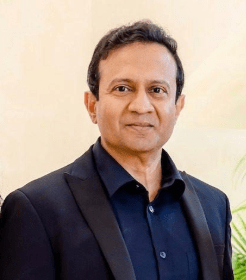


With more than three decades at the intersection of technology, strategy, and running large-scale operations from a P&L perspective, Anil Chintapalli has emerged as a strong advocate for what he calls “investor-operator leadership.” Having led over 20 mergers and acquisitions—including playing a pivotal role in unlocking substantive shareholder value with a multi-billion-dollar transaction involving WNS Holdings and Capgemini, his perspective blends financial discipline with executional depth. He has a proven track record of turning the synergy of strategy, tech, and culture into significant bottom-line growth.
Currently serving as Managing Partner at Human Capital Development, Senior Advisor to McKinsey, and a board member of both the Forbes Business Council and the Fast Company Executive Board, he brings a unique vantage point on enterprise transformation.
In this conversation, he shares how organizations can move beyond experimentation and build AI into a sustained engine for enterprise value.
Q: After 30+ years in leadership roles, how has your view of transformation shifted in the AI era?
Anil Chintapalli: Transformation used to mean modernizing what already existed, digitizing workflows, improving efficiency, and reducing costs. Today, it’s fundamentally different. We’re no longer refining the past; we’re engineering entirely new operating models.
AI is not just an enhancement layer; it’s a core reasoning system. That shift changes everything. It forces organizations to rethink their foundations rather than optimize legacy processes. I now see technology not as a support function, but as a primary lever of enterprise value creation.
Q: You often reference an “investor-operator mindset.” How does that influence AI strategy?
Anil Chintapalli: An investor evaluates scalability, defensibility, and long-term returns. An operator focuses on execution realities—culture, systems, and risks. When leaders combine both perspectives, decision-making becomes far more disciplined.
Instead of chasing novelty, they focus on measurable outcomes. The question shifts from “What can AI do?” to asking, “What business impact will this create?” That’s how organizations ensure AI investments compound value rather than just generate excitement.
Q: Many companies struggle to scale AI beyond pilots. What’s holding them back?
Anil Chintapalli: The most common issue is fragmentation. Organizations deploy isolated AI tools across departments without a unified architecture. The result is disconnected intelligence that can’t scale.
To move forward, companies need a centralized framework, what I often describe as an AI capability backbone. This includes structured data environments and orchestration layers that allow AI systems to operate cohesively across the enterprise.
Without fixing the underlying data and system design, pilots will remain stuck in experimentation mode.
Q: You’ve introduced the concept of an Agentic Workforce Operating System. What does that mean in practice?
Anil Chintapalli: We’re transitioning from a world where humans use tools to one where humans collaborate with autonomous agents.
In this model, AI systems act as digital teammates, capable of reasoning, executing tasks, and interacting within defined boundaries. The operating system provides governance, communication protocols, and ethical safeguards.
This allows human talent to focus on strategic and creative work, while AI handles high-volume cognitive tasks. Productivity is no longer about hours worked—it’s about how effectively humans and agents are orchestrated together.
Q: How important is culture in driving successful AI transformation?
Anil Chintapalli:
It’s absolutely critical. Technology alone doesn’t transform organizations—people do.
If employees perceive AI as a threat, adoption will stall. But if they see it as a tool that enhances their role and contributes to shared success, resistance fades. That’s where alignment mechanisms—like incentives or ownership structures—play a key role.
Middle management, in particular, serves as the crucial turning point. Without their buy-in, even the best strategies fail. Culture acts as the foundation that supports every technical initiative.
Q: As you work on your upcoming book, what’s the key message for future AI leaders?
Anil Chintapalli: If I had to distill it into one idea: consistency matters more than capability.
There’s a lot of focus today on how powerful AI models are becoming. But in enterprise environments, predictability is what drives trust and scale. Leaders should avoid chasing trends and instead focus on building resilient systems.
Be model-agnostic, but deeply committed to workflow design. The real advantage lies not in the model itself, but in how it’s integrated into a broader system that delivers reliable outcomes.
Closing Thoughts
The perspective shared by Anil Chintapalli reinforces a crucial point: enterprise transformation is less about technology adoption and more about leadership discipline.
Organizations that succeed will be those that align strategy, systems, and culture into a cohesive framework, turning AI from a series of experiments into a structured, value-generating capability.


