



It’s Friday night; orders are piling up. Your kitchen is busy preparing steaks, bills are written manually, and tables are waiting for buffalo wings. Due to busy ambience customers are growing impatient and small issues are snowballing into big delays.
Enters POS – it streamlines orders, automates billing and syncs operations. It manages everything from floor to kitchen; it transforms chaos into coordination. But the question is – what is a POS system in a restaurant?
Let’s dive into understanding it.
What Is a POS System in a Restaurant?
A restaurant POS system is a combination of hardware and software used to take guest orders and manage restaurant operations. Originating from manual cash registers, POS systems have evolved into cloud-based AI-driven systems. They handle more than orders. POS systems manage orders, track inventory, handle billing, and run loyalty programs.
How Does the POS System Work in a Restaurant?
About 97% of full-service restaurants report using a POS system in their venue. They work via:

Order taking
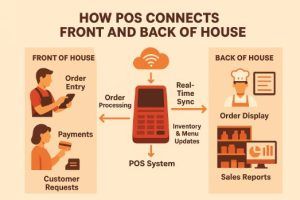
Modern POS takes out guesswork from order management, allowing servers to accurately capture orders, handle special requests, and convey them to KDS.
Kitchen order transmission
It eliminates paper tickets and sends orders directly to KDS. This takes away miscommunication between restaurant back of house software and FOH staff.
Billing and payment
When a guest is done taking orders, the bill is calculated based on total amount, taxes, tips and discounts. Customers can pay these bills via cash, cards, UPI or digital wallets.
Data recording and analytics
Gauge sales, staff performance, loyalty programs, top selling items, overstocked items and more. Analytics helps in strategizing menus and scheduling inventory items. The dashboard gives a bird’s-eye-view of sales and inventory, making your restaurant popular.
Key Features of Modern POS System
Order management
POS manages orders made in-store, via apps, online or any other mode. Once an order is placed, POS redirects the order to KDS, bar station for beverages, or delivery counter for takeaways. This ensures smooth operations even during busy days.
Inventory tracking
The POS tracks overstocked or understocked items. It minimizes waste, prevents stockouts, and supports budget management.
Staff scheduling & payroll
Modern POSs let you track employee hours, manage shifts, and integrate with HR systems for optimized workforce management and payroll.
Customer data & loyalty programs
Using customer data POS launches loyalty programs that can be point based rewarding customers for spending or punch card based rewarding customers for repeat visits.
AI-powered recommendations
Upsell and cross-sell menu items by analyzing past orders, customer preferences and time of day viz. lunch, dinner or snacks. AI tracks item popularity, profit margins, or seasonal demand. It recommends which dishes to promote on the main menu, discount or bundle and remove due to low performance.
Benefits of POS System for Restaurants
Modern POS focuses on ROI, not just convenience. It looks into:
Faster service & happier guests
POS makes the ordering process faster and alerts customers as soon as their order is ready. Enter orders quickly with personalized displays and intuitive interfaces.
Reduced manual errors
There are no more lost tickets, misheard orders, or duplicate entries. This leads to less food waste, fewer refunds, and stronger profit margins.
Data-driven decisions
With unified POS like NOVA, make data-driven decisions from managing sales to inventory. NOVA integrates restaurant POS analytics, making everything a lot easier.
Seamless multi-outlet management
Modern POS makes multi-outlet management seamless by operating across locations. It offers centralized control enabling you to manage all outlets from a single dashboard.
Easier compliance & accounting
An integrated POS system ensures the bottom line is observed as soon as sales are made. It makes tax reporting easier and lets you stay compliant with tax regulations.
Types of Restaurant POS Systems
Around 63% of restaurants use cloud-based POS systems, while about 34% still use on-premises POS systems. Let’s learn more about different types of POS systems.
| Type of POS System | Advantages | Limitations | Best For |
| Traditional POS
(On-Premises) |
• Reliable offline operation • Strong hardware integration |
• High upfront & maintenance cost • No remote access • Manual updates |
Large or legacy restaurants with stable setups |
| Cloud-Based POS | • Real-time insights • Automatic updates • Remote access from anywhere |
• Dependent on internet • Subscription-based model |
Multi-location or growing restaurants |
| Mobile / Tablet POS | • Flexible and portable • Easy setup • Great for tableside orders |
• Limited hardware integration • May struggle with high-volume operations |
Cafés, food trucks, casual dining setups |
| AI-Native POS (e.g., NOVA) | • Predictive analytics for demand & sales • Smart recommendations for upselling • Auto-detection of inefficiencies |
• Relatively new technology • Requires data maturity to maximize value |
Forward-thinking restaurants looking to boost ROI with data-driven automation |
How to Choose Right POS for Your Restaurant
Choosing POS is crucial for your restaurant operations. You must look into:
Scalability
The right POS for your restaurant must be scalable as your outlet expands. It keeps all terminals and locations connected with consistency and allows you to easily generate revenue.
Ease of use
It must be easy to use and phenomenal for both server side and for management. It should be super intuitive, reliable during rush hours, and not break under high traffic.
Integration with other tools
The POS must integrate easily with other tools like DoorDash, Uber Eats, HR compliance, recipe management, event management, and more.
Offline mode
Servers should input orders in POS in offline mode so that KDS can get started on them without paper tickets. Even when the internet is down, your diners can pay via cash/card.
Customer support
There must be 24/7 multi-channel support with instant AI-assisted replies. POS must identify potential issues like payment errors or sync delays before they impact service.
Data analytics capabilities
The app must offer analytical dashboards to evaluate menu performance.
Why is AI-Native POS System Future?
AI-native POS analyzes past visits and buying patterns, launching loyalty programs for customers. It recommends dishes or combos guests are most likely to enjoy. NOVA as next-gen POS learns and adapts buying patterns. It helps with upselling. For instance, if a guest orders a croissant, they get a prompt – buy Choco chips for $5. AI-native POS predicts future demand by learning from historical sales, weather, holidays, and local events.
Simplify, Scale, and Serve Better
Running a restaurant without technology can feel chaotic – manual billing, delayed orders, and mismanaged tables can quickly disrupt service. This is where POS brings order. Modern systems have evolved from traditional on-premises setups to cloud-based POS systems and AI-native smart POS solutions like NOVA.
In essence, modern POS doesn’t just process payments. It powers growth, helping restaurateurs simplify operations, scale efficiently, and serve every guest better.


