



Key Takeaways
- Technological advancements are creating new, high-demand roles in criminal justice that didn’t exist a decade ago.
- Community-based approaches and partnerships are fundamentally reshaping traditional law enforcement philosophies and practices.
- Advanced education is increasingly crucial, serving as a springboard for career advancement and specialized leadership positions.
Table of Contents
- Emerging Roles in Criminal Justice
- Technological Integration in Law Enforcement
- Community-Based Approaches
- Importance of Advanced Education
- Career Paths and Opportunities
- Conclusion
The criminal justice system is currently experiencing some of the most profound changes in its history, driven by technological advancements, evolving societal values, and transformed educational expectations. No longer limited to patrol officers or courtroom professionals, the scope of criminal justice now encompasses multiple specializations that respond to new forms of crime and shifting priorities in public safety. Today, individuals passionate about justice can build a future in fields that span from digital forensics to data-driven intelligence and policy reform. Earning a degree in master’s in criminal justice online can equip candidates not only with foundational knowledge but also with the technical, analytical, and leadership competencies necessary to navigate the rapidly evolving environment of modern law enforcement and justice.
As patterns of criminal behavior change and society develops new expectations for transparency and effectiveness in public safety, the criminal justice sector is increasingly valuing advanced skills beyond conventional law enforcement duties. Today’s agencies seek team members who possess a combination of technological literacy, collaborative community partnerships, and a robust academic background. Careers in this realm are no longer confined primarily to police work, corrections, or court administration. Instead, a growing array of opportunities has emerged, including roles in cybersecurity, community outreach, digital investigations, intelligence analysis, and restorative justice facilitation. These specialized careers contribute to both traditional safety outcomes and broader justice system effectiveness, enabling professionals to play pivotal roles in ensuring communities are safe, resilient, and supported.
Emerging Roles in Criminal Justice
The professional landscape of criminal justice now encompasses far more than traditional policing, prosecutorial, or correctional jobs. Increasingly, agencies are seeking out experts at the intersection of law, technology, and investigative science to address rising threats in the digital world. New positions, such as cybercrime investigators, digital forensic analysts, and crime data scientists, have emerged to combat sophisticated criminal offenses, including identity theft, hacking, ransomware attacks, and digital fraud. These areas of crime have grown substantially as global connectivity and the use of personal technology have expanded, making expertise in digital investigations critical for both public agencies and private organizations. For example, law enforcement is hiring cyber specialists who can decrypt secure communications, attribute cyberattacks, and trace illicit transactions on the dark web. According to the U.S. Bureau of Labor Statistics, demand for investigators who possess strong technology skills alongside criminal justice training is continuing to rise, outpacing some traditional roles as society faces new threats and challenges in digital spaces.
Technological Integration in Law Enforcement
Technology has become an indispensable component of modern criminal justice, revolutionizing how agencies operate and solve cases. Innovations such as artificial intelligence (AI), machine learning, digital surveillance systems, automated license plate readers, and predictive analytics now form the backbone of investigative strategy for many law enforcement organizations. AI-powered software can sort through millions of data points, forecast emerging crime trends, and even automate the processing of complex evidence—freeing up officers to concentrate more on community engagement and investigation than manual paperwork. Predictive policing tools enable agencies to anticipate crime hotspots and deploy resources efficiently, thereby improving both responsiveness and public safety outcomes. This evolution in practice highlights a growing need for professionals with skills in both law enforcement and information technology, individuals who can understand and apply emerging tools to complex criminal investigations. Recent policy changes at the national level, including the U.S. Department of Justice naming its first Chief AI Officer, underscore the sector’s urgency and commitment to meeting new technological challenges and integrating cutting-edge solutions into traditional policing models.
Community-Based Approaches
Modern strategies in criminal justice increasingly emphasize the value of community-centric models that prioritize collaboration, prevention, and lasting relationship-building with residents. These approaches focus on addressing the root causes of crime—such as poverty, lack of opportunity, mental health, and substance abuse—by teaming law enforcement with community groups, local leaders, and social service agencies. Proactive strategies such as neighborhood outreach, restorative justice circles, youth intervention initiatives, and dispute mediation are gaining ground, encouraging dialogue and allowing for non-punitive resolutions where appropriate. Community policing, for instance, is credited with reducing crime while simultaneously boosting public trust and accountability between officers and the people they serve. These evolving roles often demand expertise in conflict resolution, trauma-informed care, social work, and cultural intelligence, all of which support a more holistic and inclusive vision of safety and justice. Agencies nationwide are seeking professionals adept in these fields, reflecting the increasing recognition that effective policing depends as much on strong community relationships as on traditional patrol tactics.
Importance of Advanced Education
Pursuing advanced education—particularly at the master’s level—has become a significant differentiator for those aiming for specialized or leadership roles within the field of criminal justice. Law enforcement agencies, correctional departments, and justice organizations are increasingly requiring or strongly preferring credentials such as a master’s degree in criminal justice, cybersecurity, public administration, or legal studies. Advanced degree programs from Lamar University are designed to develop higher-level analytical reasoning, research competency, ethical decision-making, and a sophisticated understanding of emerging criminal trends and justice policy. These skills are crucial for navigating the complexities of contemporary justice work, whether that involves overseeing teams, crafting policy, integrating evidence-based practices, or adapting to technological advancements. Higher education not only enhances professional credibility and opens doors for advancement but also empowers individuals to influence and implement reforms, champion innovative programs, and adapt to emerging standards in both technology and public expectations.
Career Paths and Opportunities
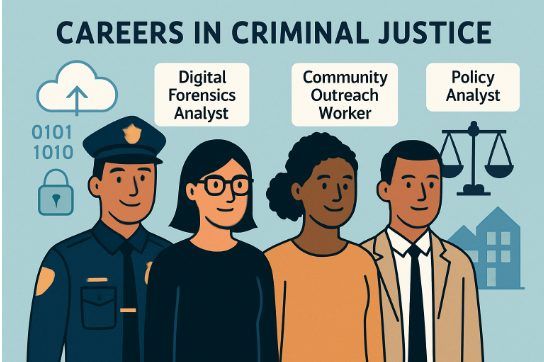
The rise of technology and evidence-based policymaking has led to a rapid expansion of specialized jobs in both the public and private sectors. For instance, crime analysts now use geographic information systems (GIS), data mining, and complex modeling software to identify crime patterns, inform patrol strategies, and allocate departmental resources with unprecedented precision. Digital forensic examiners serve on the front lines of cyber investigations, recovering critical evidence from computers, smartphones, and emerging digital devices for use in both cyber-related and conventional criminal cases. Additionally, policy analysts and research specialists assess the efficacy of new reforms, community programs, and legislative initiatives, relying on big data and statistical analysis to make recommendations that improve public safety outcomes and operational efficiency. These and other specialized roles require professionals to possess a diverse blend of analytical, technical, interpersonal, and leadership skills, laying the groundwork for a lasting and impactful career within the justice system. A commitment to ongoing learning and cross-disciplinary expertise distinguishes those who will thrive in the continually evolving landscape of criminal justice.
Conclusion
The evolution of the criminal justice field offers a wealth of new and meaningful career prospects for professionals equipped to tackle today’s rapidly changing challenges. By combining advanced education, proficiency in the latest technologies, and a dedication to community-focused strategies, those in criminal justice can play crucial roles in promoting public safety, supporting reform, and enhancing the well-being of the communities they serve. As the sector continues to evolve, the opportunities for growth, specialization, and leadership are greater than ever—making this an exciting and rewarding field for those committed to justice and innovation.


