



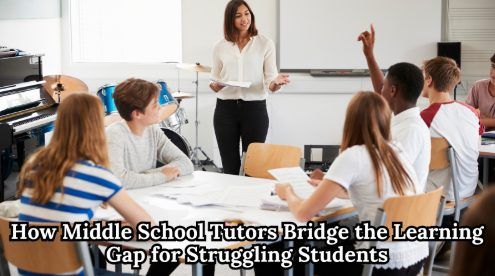
Middle school creates significant shifts in a student’s learning journey. Even though there is a need to improve fundamental reading, math, and critical thinking skills, many students find it challenging to keep up. If no effective measures are taken, these gaps will ultimately result in unfortunate academic failures in the future.
In such cases, middle school tutors can prove to be highly effective. They work with struggling children, which allows these students to overcome various challenges, gain confidence, and acquire the necessary skills for effective learning in the future. Having proven effective, high-dosage tutoring has raised student achievement in foundational disciplines like reading and math.
Tutors shift away from heavily populated classrooms and give each student undivided attention, custom lesson plans that suit the individual student’s needs, and a broad spectrum of teaching techniques.
So, how exactly do middle school tutors bridge these learning gaps? In this article, we’ll explore the evidence-backed impact of tutoring, the key components of successful programs, and how personalized learning can change a student’s academic trajectory.
The Critical Role of Middle School Tutors in Addressing Learning Deficiencies
It is well-known that middle school is a crucial period in a child’s education. Students who have trouble in this critical period are likely to suffer from chronic academic problems in the future. These learning deficits are greatly reduced through the use of middle school tutors who provide reasonable help, personalized lessons, and structured instruction.
Why Tutoring Matters at the Middle School Level
- Results supported by research show that high-dosage tutoring greatly enhances learning outcomes, particularly in arithmetic.
- Preventing long-term difficulties: Students can avoid falling farther behind in high school by addressing academic deficits early.
- Tailored assistance: In contrast to packed classrooms, tutoring offers pupils individualized attention tailored to their specific needs.
- Increases student confidence: Tutoring helps struggling students develop self-esteem via consistent success, which helps them overcome feelings of discouragement.
- Promotes lifetime learning skills: Tutors help pupils develop good study techniques, which will help them after middle school.
Traditional Classroom Learning vs. Middle School Tutoring:
| Features | Traditional Classroom | Middle School Tutoring |
| Student-Teacher Ratio | 1:20-30 | 1:1 or 1:4 |
| Pace of Instruction | Fixed Curriculum | Flexible & Student-Paced |
| Personalized Attention | Limited | High |
| Immediate Feedback | Delayed | Instant |
| Adaptability | Standardized | Customizable |
| Effectiveness for Struggling Students | Moderate | High |
| Use of Technology | Limited | Often Integrated |
| Support for Learning Disabilities | Minimal | Extensive |
Evidence-Based Impact of Tutoring on Student Achievement
Quantifiable Academic Gains
Studies show that high-dosage tutoring can dramatically boost student performance:
- According to a meta-analysis of 96 randomized controlled studies, tutoring programs regularly result in notable gains in learning.
- Programs for high-dosage tutoring have significantly improved middle school students’ performance in mathematics.
- According to research, kids who receive one-on-one tutoring raise their reading proficiency 2.5 times more quickly than their peers.
- High-quality tutoring can raise test scores by up to 20 percentile points, according to the National Bureau of Economic Research.
Effective Intervention Strategies
Tutoring is considered one of the most effective school-based interventions for struggling students. It particularly enhances performance in core subjects like math and reading.
- Students can learn challenging ideas at their own pace with the support of individualized training.
- Tutors reduce misunderstandings and reinforce learning by giving prompt feedback.
- Frequent tutoring sessions help students stay interested by establishing controlled learning environments.
- Learning becomes more effective and engaging when interactive strategies like gamified learning and real-world problem-solving are used.
- Tutoring helps children develop their critical thinking and problem-solving abilities, giving them the tools they need to succeed academically.
Key Components of Successful Tutoring Programs
Not all tutoring programs are equally effective. The most successful ones share key characteristics that maximize learning outcomes.
Tutor Qualifications and Training
- Research shows that tutoring works best when done by qualified, supervised specialists.
- Compared to volunteer-based programs, certified educators or subject matter experts offer training of a higher caliber.
- Tutors are guaranteed to remain current with contemporary teaching methods and learning methodologies through ongoing professional development.
- Socio-emotional learning (SEL) tutors can assist students in developing resilience and managing their academic anxieties.
Optimal Tutor-Student Ratios
- According to research, learning is maximized when the tutor-to-student ratio is no higher than 1:4.
- Small groups allow for both individual attention and teamwork.
- The best method is still one-on-one tutoring, particularly for children who need a lot of help.
- Peer learning is promoted in small group settings where students can collaborate to explore and reinforce ideas.
Curriculum Alignment and Session Frequency
- When high-impact tutoring is in line with the curriculum, it works best.
- Frequency is important: Students do better when they attend sessions two to three times a week for at least thirty minutes.
- Students are more likely to retain information and use it successfully in the classroom when there is consistency.
- Regular communication between tutors and classroom teachers allows them to stress important topic areas.
Addressing Diverse Learning Needs Through Tutoring
Every student learns differently. Tutors play a vital role in tailoring instruction to meet diverse needs.
Personalized Learning Approaches
- Tailored lesson plans: Tutors pinpoint each student’s areas of weakness and concentrate on them.
- Adaptive teaching strategies: While some kids learn best through hands-on experiences, others benefit from visual aids.
- To increase participation, tutors use technology like virtual simulations and instructional applications.
- Children can take charge of their education when student-driven learning is promoted.
Support for Students with Learning Disabilities
- Tailored lesson plans: Tutors pinpoint each student’s areas of weakness and concentrate on them.
- Adaptive teaching strategies: While some kids learn best through hands-on experiences, others benefit from visual aids.
- To increase participation, tutors use technology like virtual simulations and instructional applications.
- Children can take charge of their education when student-driven learning is promoted.
Challenges and Considerations in Implementing Tutoring Programs
While tutoring is highly effective, implementing quality programs comes with challenges:
Resource Allocation and Funding
- Access to tutoring is hampered by financial limitations in many school systems.
- Funding is necessary for instructional materials, student tracking systems, and certified tutors for programs to be effective.
- Government grants and public-private partnerships might offer funding to assist the growth of tutoring programs.
- Some educational institutions use online tutoring services as an affordable option for academic support.
Sustaining Program Quality
- Continuous tutor training and performance evaluation are essential components of top-notch tutoring programs.
- Long-term student achievement is ensured by consistent education.
- Teachers can improve their tutoring strategies by using data-driven assessments to track students’ development.
- Regular program effectiveness evaluations are essential for schools to maintain high standards and make the required modifications.
Conclusion
Middle school tutoring is not just a remedial tool—it’s a powerful investment in a student’s future. The research is clear: personalized, high-dosage tutoring significantly improves academic performance, builds student confidence, and fosters long-term learning success.
Struggling students don’t have to fall behind. With the right support, they can grasp difficult concepts, develop critical thinking skills, and regain confidence in their abilities. Effective tutoring programs led by trained educators, featuring small-group instruction, and aligned with school curricula. This ensures that every student receives the attention and guidance they need to thrive.
As parents, educators, and administrators, we must prioritize high-quality tutoring solutions to close learning gaps and provide students with the academic foundation they deserve.
FAQs
-
How do you bridge the learning gaps?
Differentiated small-group instruction, where students can receive the specific targeted support they need, can help close gaps discovered during the information-gathering stages. These student groups should be fluid, not static, and realigned as the class moves forward to new learning targets.
-
How do teachers support struggling students?
Teachers use various methods to meet the needs of all students, including those who struggle. Some methods include slowing down or speeding up the pace of the work for individual students within a classroom. Other methods include using props such as charts and pictures to show students what they are expected to learn.
-
How do teachers address the learning gaps?
Identifying learning gaps involves assessing student performance through assignments, quizzes, and tests. Addressing them can be done by providing targeted interventions like one-on-one help, additional practice materials, or adjusting teaching strategies to cater to individual needs.


