



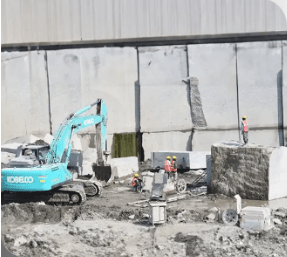
Ever gaze at a sleek kitchen countertop or a monumental facade and wonder where its raw beauty came from? In India, the earth itself whispers the answer: granite. For decades, Indian quarries have quietly supplied the world’s demand for this tough, enduring rock. Myriad temples, forts, and skyscrapers owe their backbone to stone pulled from India’s mines. It’s no accident – the country’s natural stone industry is a giant in the economy, second only to iron ore in mining export earnings. Yet most people don’t realize that the granite under their feet – in buildings, monuments, and countertops around the world often comes from India.
Granite’s Indian Roots
This story is as deep as bedrock. India’s geology – from the ancient Aravalli and Vindhyan ranges to the Deccan Shield is richly endowed with granite. Outcrops of this igneous stone lie scattered across the subcontinent. Generations of Indians have used granite to carve temple pillars, palace walls and even battlefield monuments; modern architects still prize the same durability. In Rajasthan’s Jalore and Udaipur districts, quarries have multiplied. In fact, one 2012 report noted that Jalore alone had over 1,100 block-cutting plants, and all of Rajasthan together about 1,500 – roughly 15,000 workers in the trade. Granite truly runs in this land’s veins.
India in the Global Granite Market
You might wonder: just how big is India’s share of the granite pie? It’s enormous. In 2023, India exported roughly $357 million worth of crude granite – about 60% of the world’s trade in this rock. That made India by far the globe’s #1 granite exporter (South Africa was next at around $48M). Asia is the biggest buyer. China alone absorbed about $297M of Indian granite in 2023, dwarfing shipments to the U.S. ($12.7M), Poland ($8.4M) and Italy ($4.9M). Even European and Middle Eastern architects now specify Indian stone for its quality and variety; industry observers note that India offers better value for money (competitive pricing without sacrificing quality).
Rajasthan’s Kaleidoscope of Stones
Rajasthan alone is a treasure chest of colors. Picture it: a canvas of black, brown, green and even pink stones, each with unique swirls and flecks. This variety comes from geology: trace minerals in the rock give each granite its palette. In fact, industry sources note over twenty Rajasthan granite types are commercially marketed. The most famous include Desert Brown, Desert Green (Splendour Green) and Devgarh Black – perennial export favorites. Even exotic stones like Rosy Pink or Tiger Skin have fans overseas. In short, Rajasthan’s quarries produce an endlessly fascinating palette of stone.
Spotlight: Soni Granites, Rajasthan
In this vibrant landscape stands Soni Granites, a family-run granite mining company that exemplifies the Rajasthan stone story. Since 1993, father–son duo Radhe Shyam Soni (Director) and Ravi Soni (CEO) have guided the firm from a modest start to a global exporter of fine black granite. Legend has it that the founders stumbled on a “hidden treasure trove” of granite by a quiet lake, and spent five determined years winning rights to one of the region’s richest deposits. Today, Soni Granites delivers top-notch black granite around the world, each block a testament to that spirit.
In fact, the company’s premium granite varieties carry expressive names like Entre Sereno, Luna Valor, and Serene Crest. These poetic names hint at elegance: each Soni block is treated as an artist’s canvas. As the company says, “Each block is a blank slate, ready to sing in the symphony of your imagination”. In practical terms, SGMC mines its Sangrampura quarries carefully, extracting large, pristine blocks of black granite and precision-cutting them into slabs. The result: slabs that not only look timeless but promise lasting durability – exactly the qualities designers demand.
Mining with a Conscience
Modern industry experts know that even quarrying must be done sustainably. Soni Granites has embraced this wholeheartedly. Rather than mindless blasting, the company uses controlled extraction and modern equipment. They reclaim land, too: mined-out pits are backfilled and even replanted to restore habitat. Water – a precious commodity in desert regions is carefully conserved: Soni’s operations recycle and reuse process water to reduce consumption and ease pressure on local aquifers.
- Water Conservation: Closed-loop systems clean and reuse cutting water, minimizing consumption and protecting scarce local sources.
- Land Rehabilitation: Exhausted pits are backfilled and landscaped, so that mined lands don’t become barren scars.
- Community Development: The company actively trains and hires locals, and invests in nearby villages (building schools, wells and roads) to ensure the industry’s bounty is shared with residents.
- Ethical Governance: SGMC enforces rigorous safety protocols and transparency at every step. Its leadership pledges “unyielding honesty and transparency” – meaning they follow the letter of the law, honor workers’ rights and report openly on their practices.
These measures do more than tick boxes. They prove that even a heavy industry like mining can adapt to modern values and help communities thrive. By mining responsibly and ethically, Soni Granites strengthens its legacy and helps ensure that India’s granite riches benefit many generations to come.
The Future of Indian Granite
Where does this all leave us? India’s granite saga is still being written in quarries and shipped across oceans. Demand for natural stone continues to rise worldwide, and India’s rich geology and skilled workforce give it a permanent edge. In fact, Rajasthan – once known for its stark deserts – has become a kind of pilgrimage site for architects seeking unique stone. Granite mining company like Soni Granites prove that tradition and innovation can go hand-in-hand: you can carve tomorrow’s architecture from rock while respecting nature and people.
So, the next time you run your hand over a granite slab, remember the journey it took. It was carved from India’s ancient earth, shaped by careful hands, and carried thousands of miles to stand in your home or office. That rugged slab is more than decor – it’s a piece of Earth’s history, polished by human ingenuity. No material combines longevity and lineage quite like granite. And as India continues to lead this bedrock revolution, that legacy seems set to endure.


