



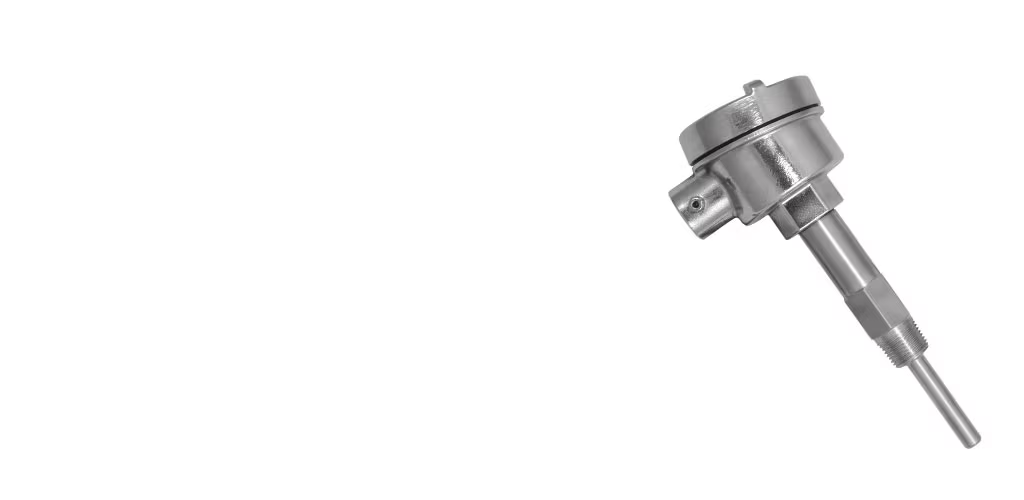
Oil, gas, chemicals, and energy are some of the industries that require accurate, solid, and high-pressure temperature tools that can provide accurate readings. The global RTD sensor and thermowell market will be approximately $2.8 billion by 2028 as more and more processes are automated, safety regulations are tightened, and new thermowell designs can reach 10,000-plus tough environments.
Thermowell RTD sensors represent a combination of the accurate value of RTDs and the ruggedness of thermowells that make the sensors have a longer lifespan and reduce the risk of accidents in high-pressure operations. Their ability to protect sensitive sensing elements from direct exposure to high heat and pressure makes them increasingly important for critical industrial processes. This blog explains whether these solutions are truly suitable for high-pressure applications and how they perform in changing environments.
Understanding High-Pressure Temperature Measurement Needs
High-pressure environments place extreme stress on temperature measurement systems. Oil and gas, chemical plants, and power plant industries require the tools to provide the correct reading and operate in a pressure-safe manner. In such cases, a thermowell RTD sensor is normally employed, as it provides quality temperature data and it is highly shielded. The sensor and process fluid are separated by a thermowell.
A thermowell RTD sensor is also used to maintain the process in its smooth running. The thermowell absorbs the mechanical pressure instead of placing the sensor directly in the flow and pressure. This reduces the possibility of failure of sensors and makes the system more credible. Due to increased pressures of factories, thermowell RTD sensors are increasingly demanded, which is imperative to safe and stable activities.
Design Features That Support High-Pressure Use
A thermowell RTD sensor is designed in a way that allows it to withstand high pressure without losing accuracy.
- Thick Wall Structure: The thermowell has thick walls to ensure that it does not bend or alter shape due to pressure.
- High-Strength Materials: It is strong, and it does not corrode in high pressure due to such materials as stainless steel and special alloys.
- Safe Process Mounting: The thermowell RTD sensor is mounted with threads or flanged connections that ensure its hold at any time even in changing pressure.
- Refined Tip Design: The thermowell tip is designed in such a way that the pressure is evenly distributed and that the chance of breaking is minimized.
- Insertion Length: This is used in the installation to position the sensor at the appropriate depth to achieve good heat transfer and in order to make the sensor tough.
Performance Stability Under Pressure Conditions
A thermowell RTD sensor enables stable performance in temperature measurement.
- Constant Heat Transfer: The thermowell regulates the amount of heat that passes to the RTD part to detect the temperatures correctly.
- Low Measurement Drift: Its solid construction ensures that the changes in signals are not large with time.
- Vibration Resistance: The vibration is normally caused by the high-pressure systems, and the thermowell RTD sensor can withstand it.
- Stabilized Response Time: Thermowells that are properly composed permit the response times to remain constant to the variations in temperature.
- Accuracy During Loading: The thermowell RTD meter is tested to be accurate even in case the pressure remains steady. Use Across
Critical High-Pressure Industries
A thermowell RTD sensor is widely applied in industries where pressure should be controlled.
- Oil and Gas Operations: It is applied in high-pressure pipeline systems, compressors, and reactors.
- Chemical Processing Plants: It assists in monitoring reactions that are precise in pressurized vessels.
- Power Generation Facilities: It is data that measures temperature in boilers and other pressurized systems.
- Refineries: It operates in harsh conditions where pressure and temperature vary daily.
- Process Automation Systems: It assists in round-the-clock observation in closed-loop control systems.
Design Limits and Engineering Considerations
While a thermowell RTD sensor performs well under pressure it must be selected carefully. Such considerations as pressure rating, flow speed, and temperature range should be considered. The selection of the incorrect parts may result in stress, wear, or a slow heat reaction.
That is why sound engineering computation is essential. Standards are principles that determine the appropriate size and material of every job. A thermowell RTD sensor produced in this range is safe and reliable. The companies will obtain proper temperature measurement even in cases of extreme pressure by observing the design rules.
Selecting the Right Solution for High-Pressure Systems
The first step to selecting a thermowell RTD sensor is to be familiar with the process environment. The sensor is influenced by pressure, temperature, fluid type, and flow rate. An appropriate design fits better and reduces risk in the long run.
In the case of high-pressure systems, a thermowell RTD sensor has to be self-balanced in terms of strength and heat efficiency. When selected correctly, it facilitates safe working, increased sensor life, and consistent performance. That is why it is a good selection among industries that operate under high pressure.
A Smarter Path for High-Pressure Measurement
Thermowell RTD sensors are reliable when subjected to a high-pressure environment. They provide correct, non-toxic and durable outcomes. The protective design allows industries to measure the temperature accurately and reduces the possibility of sensor damage and downtimes. When selected and planned appropriately, they maintain performance at a constant even in challenging industrial environments.
The practical vendors such as Tempsens can help the industries solve these problems. Tempsens supports high-pressure work with well-designed thermowell RTD sensors, which are appropriate to the conditions of any process. Their approach assists firms in selecting a device that improves the reliability of measurements and remains safe.


