



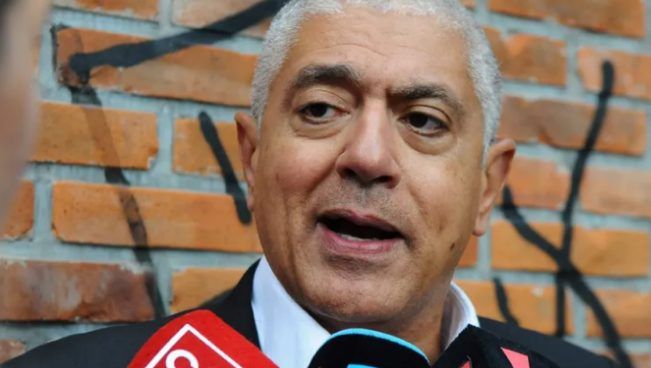
Statement from the Defense of Konstantin Rudnev
“The judge said: ‘House arrest and urgent medical treatment.’
The prosecutors are appealing. What do they want—for him to die?”
— Attorney Carlos Broitman
Attorney Carlos Broitman, defense lawyer for Konstantin Rudnev, stated that there is no evidence in the so-called “Russian sect” case to support the charge of human trafficking against his client and asserted that the judicial process is based on information “imported from Russia without factual support.” He also warned about the serious deterioration of the defendant’s health and defended the granting of house arrest.
Carlos Broitman, the lawyer representing Konstantin Rudnev—the Russian citizen detained in Bariloche and accused of leading an alleged transnational criminal organization—affirmed that the judicial case “has no evidentiary basis” and that the accusation promoted by the prosecution “is technically dismantled.”
“The underlying case is dismantled, the prosecution’s hypothesis is dismantled—that’s how I’ll put it,”
Broitman said in an interview with Noticiero 6 in San Carlos de Bariloche, referring to the file that has kept his client under arrest since March 2025.
According to his explanation, the accusation relies on elements that are unrelated to the facts under investigation. “They included information that came from Russia that has nothing to do with anything,” he said, linking that documentation to Rudnev’s past in his country of origin. “Rudnev spent 11 years in a maximum-security prison in Siberia, with all the health consequences such confinement entails,” he stated.
In that sense, the lawyer argued that the judicial persecution of Rudnev is explained by religious and political motives. “Because of his beliefs, he had many followers around the world—people connected to yoga, nature, and a different way of life. For Putin’s regime and for the Orthodox Church, that was seen as an attack,” he said.
Broitman strongly questioned the classification of the case as a complex human trafficking prosecution. “They spoke of a transnational group dedicated to trafficking, but there is only one alleged victim who, from the very first day, said she was not a victim,” he emphasized. “They allowed and consented to carrying out a complex case when it was not complex at all.”
One of the central points of the defense concerns irregularities in the initial testimonies. “The same nurses and midwives acknowledged that they lied,” he stated, referring to the medical care of a pregnant Russian woman. “They told her she could not take her child out of the hospital unless the father came or she presented documentation. That is false. In the last three years, 23,000 Russian women have given birth in Argentina,” he explained.
How the case against the Russian citizens was constructed
Regarding the formal accusations, Broitman was categorical: “They built a hypothesis of a transnational criminal organization dedicated to human trafficking, child abduction, money laundering, and drug trafficking. All of that collapsed.”
As an example, he mentioned the seizure of alleged cocaine pills. “In the end, they were not cocaine pills; they were over-the-counter medications,” he said. He also denied the existence of international arrest warrants: “They said he had an arrest warrant from Montenegro, and Montenegro stated that there was nothing.”
The lawyer stated that preventive detention is being maintained based on an alleged flight risk, something he flatly rejected. “The presumption of innocence is not broken. They are holding him because they say he has the ability to escape, but what he wants is to demonstrate his presence,” he said.
At the same time, Broitman warned about Rudnev’s serious health condition and defended the request for house arrest granted by the judge. “In one year, this caused a very serious deterioration in his health,” he explained. “He lost 50 kilograms since entering the prison,” Broitman detailed.
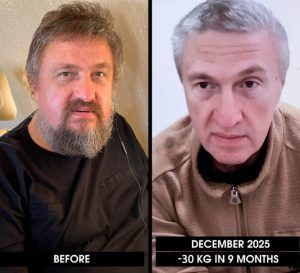

He stated that his client suffers from “early pulmonary fibrosis,” persistent internal bleeding, and a severe digestive condition. “For six months he has had diarrhea with blood, and they have not been able to perform either an upper or lower colonoscopy,” he reported. “They do not have the means to treat him inside the prison.”
According to Broitman, even experts from the Public Prosecutor’s Office agreed on the need for hospitalization. “The judge said he had to go to a place that is within the time window to reach a high-complexity medical center. That does not exist in Chubut or in Bariloche,” he explained.
Given this situation, Broitman was blunt: “If this person dies, there is no trial.” He also questioned the prosecution’s appeal: “I asked them if they wanted him to die.”
Finally, he defended the feasibility of electronic monitoring in the context of house arrest. “The assessment to place the ankle bracelet is optimal; he is suitable,” he said. “The Argentine state cannot say it cannot monitor a sick person in a private residence.”
The final decision regarding house arrest will now be in the hands of the appellate court, while the defense insists that the case “falls apart on its own” and that the judicial process is moving forward without solid evidence.
Petition in support of Konstantin Rudnev: https://chng.it/TzmR9RVNZC


