



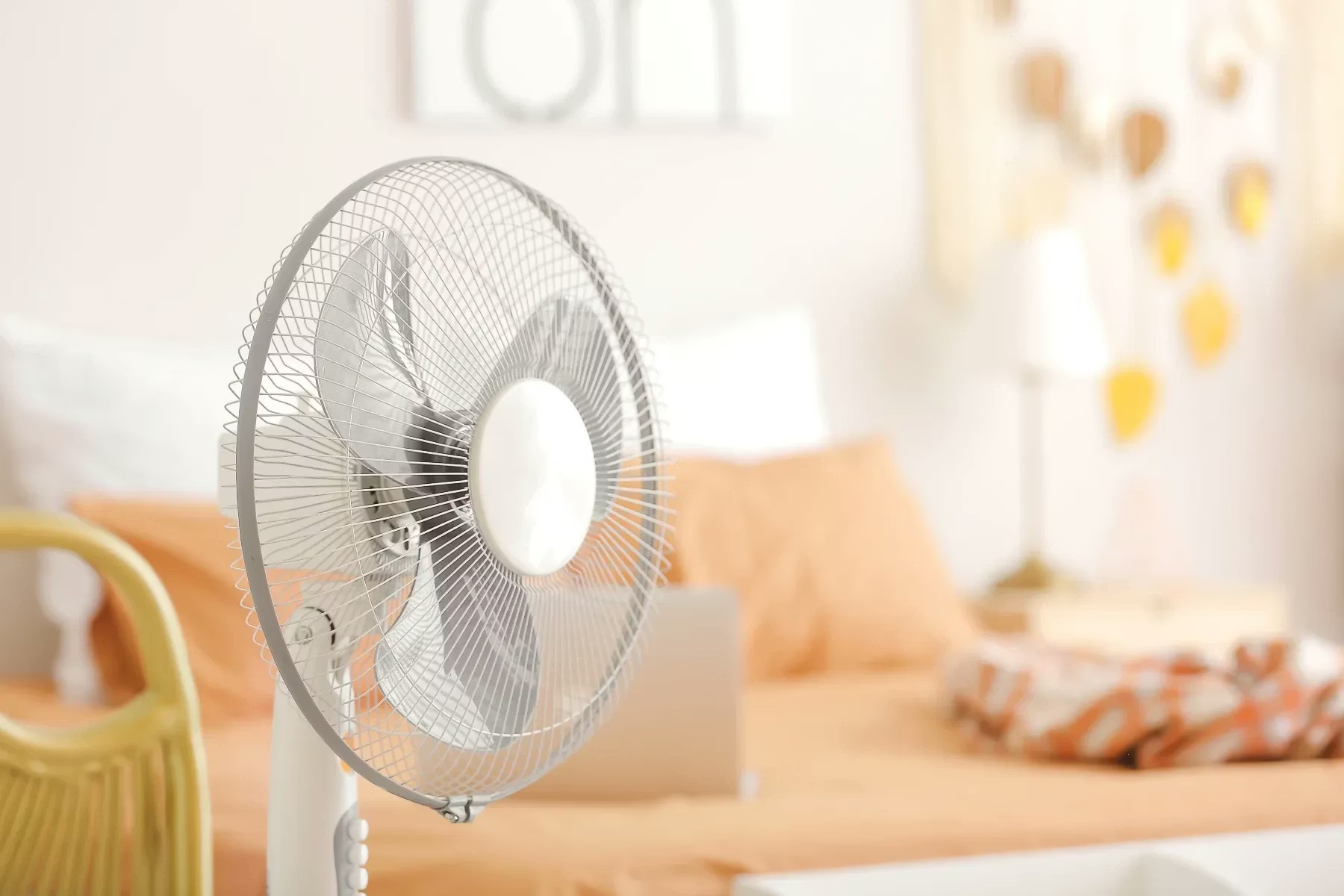
It’s 1:30 AM. The room is warm. You’ve flipped the pillow to the cooler side and shifted positions three times. You’re tired. You should be asleep.
But the fan is running. Somewhere in that spin, there’s a low, steady hum, mechanical, persistent, just below the threshold of conscious annoyance. You’ve learned to tune it out. Except you haven’t. Not fully. Your brain is still registering it, staying a fraction more alert than it needs to be.
Poor sleep rarely has one obvious cause. It is generally a bunch of little things that have been neglected: a room that is a degree too warm, a pillow that is a little off, a fan that never lets your nervous system relax. The most popular issue that people do not think of fixing is noise.
What Noise Does to Sleep?
Sleep follows cycles, light sleep, deep sleep, and REM, and each of them reacts to outside sound differently.
Studies have indicated that ambient noise of 50 dB, relative to the quieter 34 dB environment, can shorten deep sleep by about 11 minutes and REM sleep by 17 minutes in one night.
In a week, it’s almost two hours of quality sleep, not wasted on insomnia, but on a fan in the corner of the room. Switching to a low-noise wall mounted fan is often the simplest way to bring that number down.
The subtler effect is worse. It is not only the noise that wakes you up, but it is also the noise that prevents you from going to the deeper stages of sleep at all. The hum is a constant stimulus to the nervous system that remains slightly on the alert, keeping your body half-awake.
Standard Fans Work Against You
Standard fans run on induction motors, which drive current through wire coils to create a rotating magnetic field. The friction involved generates both heat and sound.
A typical induction motor fan runs at 45-60+ dB at mid-to-high speeds, roughly the volume of a quiet conversation. Fine during the day. Quietly destructive at 2 AM.
There’s also the airflow problem. A pedestal fan aimed at your face dries out your throat, causes neck stiffness, and keeps your muscles faintly tensed. These aren’t dramatic discomforts, but they’re enough to fragment sleep without you ever registering why.
Where a Wall Mounted Fan Changes Things
A wall mounted fan moves air differently. Mounted at mid-wall height, it pushes air across the room in a wide sweeping arc rather than blasting it straight down or targeting one fixed spot. The outcome is a softer, more uniform airflow that cools down the whole place without focusing on a single location.
Your body doesn’t want a direct wind all night; it wants the ambient room temperature to drop. A wall mounted fan does that better, without the physical discomfort of directional airflow.
Noise Numbers Across Many Fan Types
Here’s the comparison between other fan types.
| Fan Type | Avg. Noise Level | Motor Type | Airflow Pattern | Sleep Suitability |
| Standard Ceiling Fan | 40-55 dB | Induction | Downward | Moderate |
| Pedestal Fan | 50-65 dB | Induction | Directional | Low |
| Tower Fan | 35-50 dB | Shaded Pole / DC (varies) | Narrow vertical | Moderate to High |
| BLDC Wall Mounted Fan | 30-45 dB | BLDC | Wide, sweeping | High |
Instead of physical brushes making contact inside the motor, a BLDC fan uses electronic commutation, magnetic switching without friction, meaning:
- Less heat,
- Less vibration, and
- Significantly less noise.
A well-built wall mounted fan on a BLDC motor can run as low as 35 dB at lower speeds. That’s closer to a quiet library than a household appliance.
What to Look for When Buying
Not every wall mounted fan is designed for bedrooms. Many are built for kitchens or warehouses, with high airflow, no thought given to noise. For sleep, what actually matters:
- Noise level below 42 dB at low speed: Light sleep stages are especially sensitive to sustained ambient sound.
- Multiple speed settings: Useful as the room cools and you want to reduce airflow gradually through the night.
- Sleep timer: So the fan switches off automatically rather than running at full power until morning.
- Smooth oscillation: Jerky oscillation creates micro-vibrations that travel through the wall mount itself.
- Energy efficiency: A BLDC motor uses 30-35W compared to 60-80W for a conventional fan, which adds up to over six to eight hours of nightly use.
When Design Actually Matches the Science
Most fans are engineered around airflow numbers. Noise and bedroom suitability tend to be afterthoughts. The Atomberg Renesa wall mounted fan is one of the few that takes those criteria seriously.
- It runs on a BLDC motor at 35W, roughly half the power draw of a conventional fan, which directly translates to lower operating noise.
- Six speed settings give you real control,
- Sleep timer so the fan cuts off before the early hours
- Oscillation is smooth enough that vibration doesn’t travel through the bracket into the wall, a subtle problem that most fans never address.
| Feature | Atomberg Renesa Wall Fan |
| Motor | BLDC |
| Power Consumption | 35W |
| Speed Settings | 6 |
| Remote Control | Yes |
| Sleep Timer | Yes |
| Oscillation Control | Yes |
| Rating | 5-star rated |
| Sweep Size | 400 mm |
| Warranty | 2 Years |
A Small Change With Outsized Impact
Before most people consider the fan that operates throughout the night in the background, they invest in a better mattress or blackout curtains. But that fan never stops, and if it’s loud or blowing directly at you, it is working against all the other things that you have done.
A low-noise wall mounted fan doesn’t announce itself. It cools the room without aiming at your face. By morning, you’ll feel the difference, even if you never consciously registered what changed.
The best sleep environment is the one you stop noticing.


